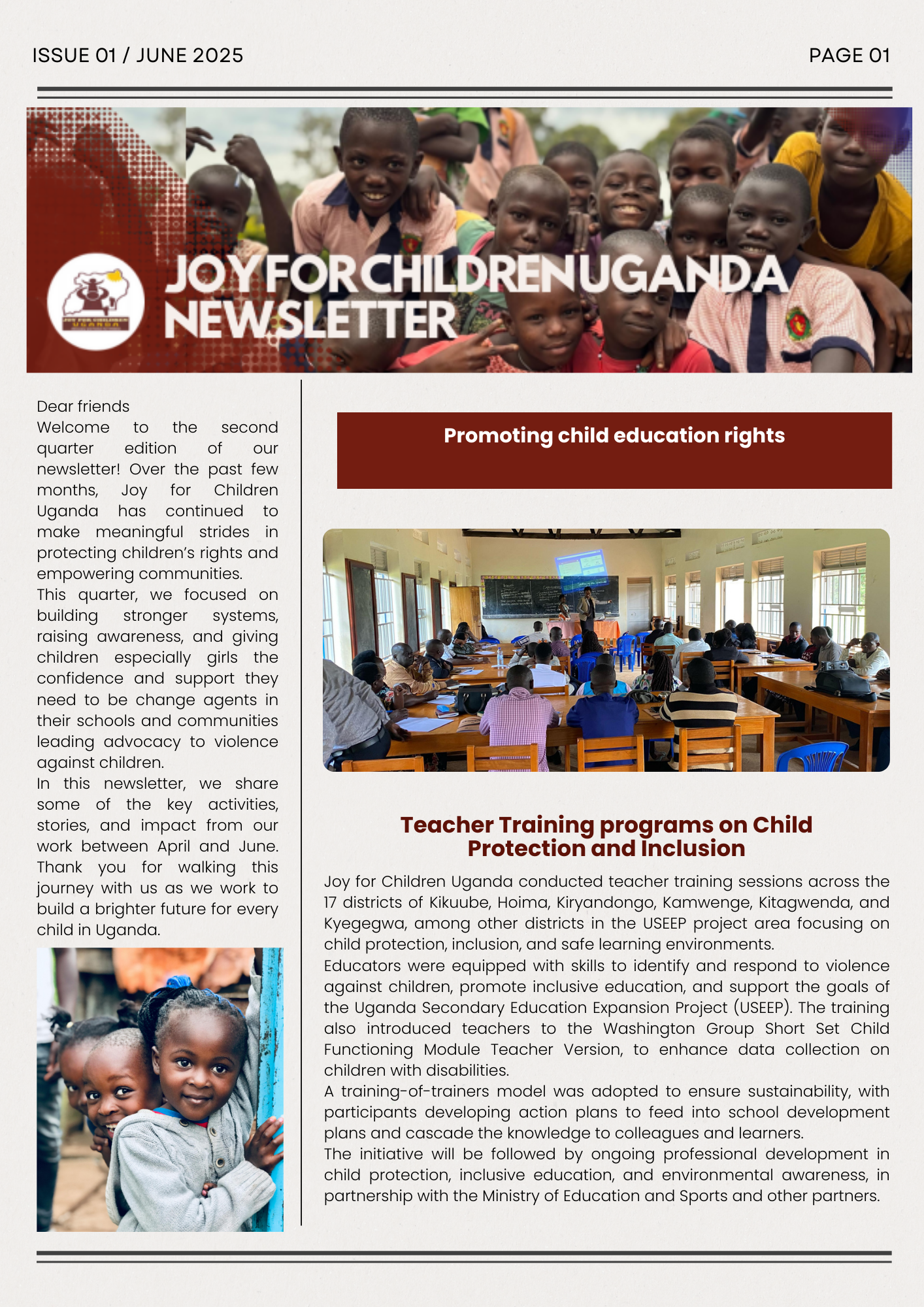
JFCU trained teachers across districts in the USEEP project area on child protection, inclusive education and safe learning environments. The training strengthened identification and response to violence, introduced disability-inclusive data tools and used a training-of-trainers model so knowledge can be carried into school development plans.
From Joy for Children Uganda
Welcome to the April–June 2025 edition. This quarter focused on stronger child-protection systems, inclusive education, community health, girls’ leadership and advocacy led with children and communities.
Teacher training on child protection and inclusion
Equipping schools with practical protection resources
In partnership with Windle International Uganda, schools in Western Uganda received information, education and communication materials on gender in education, teenage-pregnancy prevention, adolescent support, referral pathways and violence prevention. Smart televisions and sports equipment also supported learning, teamwork and inclusion.
Community health workers strengthening HIV care
Community health workers in Kyenjojo District strengthened their skills in data collection, case identification, linkage to care and referral for HIV-positive mothers and infants. The work supports reliable prevention, care and treatment while reinforcing collaboration between young people, health workers and partner organisations.
BLOOM project beneficiary mapping
With support from Aidsfonds, JFCU brought together community health workers, religious and local leaders, health-facility teams and young mothers to map key beneficiaries and stakeholders for the BLOOM project. The exercise supports young mothers and children living with HIV and strengthens referral coordination across five sub-counties.
Girls’ advocacy and leadership
The second Girls’ Advocacy and Leadership cohort equipped student leaders with knowledge on sexual and reproductive health and rights, life skills, confidence and leadership. Participants are being supported to advocate against child marriage in their schools and communities and to build a collective Girls’ Agency.
Child sponsorship and family follow-up
JFCU’s sponsorship programme supports children from vulnerable households with school fees and essential scholastic materials. Follow-up visits in Kabarole District reviewed academic progress, documentation and the wider household support needed for children to thrive.
National advocacy and learning events
The quarter included participation in the World Day Against Child Labour, Menstrual Hygiene Day, the Girls First Fund grantees convening, the East Africa Philanthropy Conference and a paediatric HIV learning workshop for Aidsfonds partners. These spaces strengthened advocacy, collaboration and accountable programme learning.