A Conversation on Rights, Access to Justice and Action for All Women and Girls in Uganda.
Human rights are universal and protected under both international and national legal frameworks. Uganda is a signatory to key instruments such as the Convention on the Rights of the Child (CRC), Convention to End Discrimination Against Women (CEDAW) and the Maputo Protocol. These frameworks guarantee every girl and woman the right to protection from violence, abuse, neglect, and exploitation; the right to education; sexual and reproductive health and rights (SRHR); and the right to access justice.
However, despite these protections, many girls and women remain at risk of serious human rights violations. Sexual abuse, early marriages, exploitation and child labor are just some of the violations girls and women are exposed to. UN Women reports that an average of 137 women are killed daily worldwide by intimate partners or close relatives. According to the Uganda Police Force Annual Crime Report (2024), 12,009 female juveniles were defiled compared to 308 male juveniles. These figures not only reveal the gendered nature of sexual violence but also underscore the heightened vulnerability of girls in our communities. Behind each statistic is a female whose right to dignity, safety, education, and development has been severely violated.
The year 2026 reflects notable progress for Uganda, more women-owned and led businesses, more girls accessing education, more equal opportunity employers, and more outspoken women and girls advocating for their rights. The Government of Uganda has ensured women’s representation in Parliament stands at approximately 33.9% of seats, and the country has achieved about 80% of legal frameworks promoting employment and economic benefits for women (UN Women).
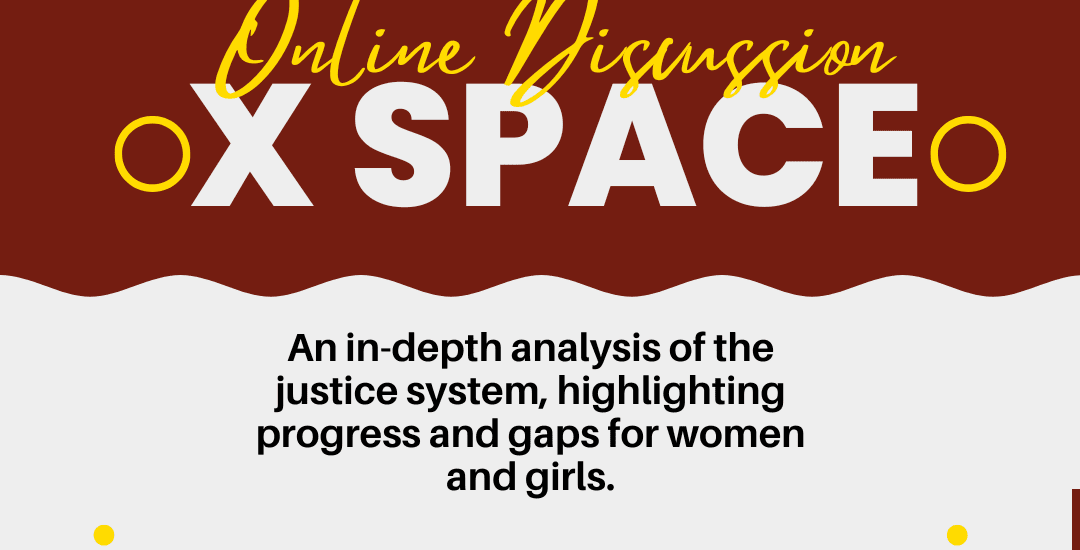
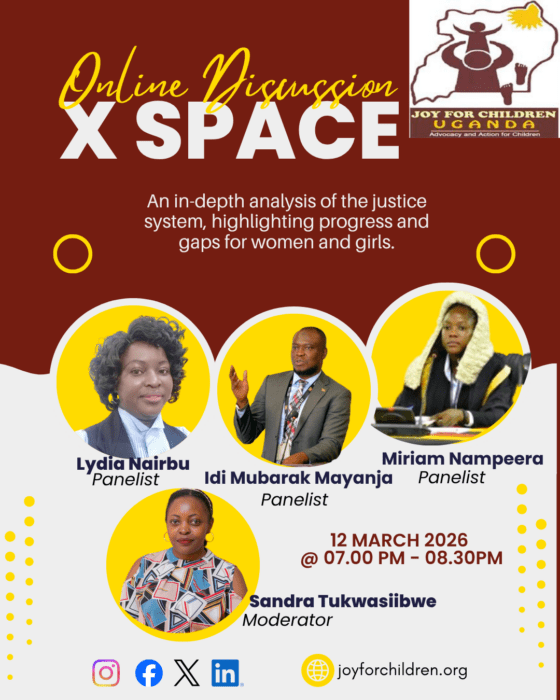
In celebration of International Women’s Day, Joy for Children Uganda (JFCU) hosted an X Space discussion on March 12th, 2026, with the topic; Analyzing access to justice for women and girls in Uganda by highlighting the achievements and gaps. This conversation brought together gender experts, government officials and civil society advocates, who engaged in an extremely evidence-based and solutions-oriented conversation.
Sandra Tukwasiibwe, the host and Head of Programs at JFCU, opened the space with an overview of what justice looks like for women and girls in the country. Noting that the government body itself is a representation of the efforts the country is making in ensuring that Sustainable Development Goal 5 that aims to achieve gender equality by 2030 is realized. Women representation in parliament is at 34%, with more women taking up top positions the Vice president, speaker of Parliament and the Rt. Hon Prime Minister are all female. However, increased female representation in decision-making spaces does not erase the persistent gaps that remain. Many women and girls still lack meaningful access to justice.
The panelists for this space included Hajji Mayanja Idi Mubarak, Principal Women in Development Officer at the Ministry of Gender Labor and Social Development, Lydia Nairuba, Legal officer and Project Officer Uganda Women’s Network (UWONET) and Miriam Nampeera a lawyer working with International Federation for Female Lawyers (FIDA) Uganda.
Key Contributions From Panel
Hajji Idi Mayanja Mubarak
Idi spoke of the progress the Ministry of Gender Labor and Social Development has made in ensuring all women and girls have equal access to justice. Starting with the education sector, enrollment of girls and boys right from primary school has increased, in the health sector, maternal mortality rates have decreased and in the political landscape, with the cabinet at almost 47% of women.
Idi reemphasized the need for economic justice for girls and women, governments actions to ensure girls and women are empowered economically. Idi, noted that indeed implementation is low, but the government through the ministry has made great progress. Through the new National Action Plan, one of the key areas is to strengthen implementation of existing laws and revision of those with gaps. The ministry has been able to also establish special court sessions that provide speedy access to justice for women and girls, with closed door hearings that protect the survivors.
Most of the activities the Ministry carries out are geared towards economic empowerment for women and girls. Flagship programs like Parish Development Model (PDM), Uganda Women Entrepreneurship program, Youth Livelihood and GROW have increased efficacy for women and girls to access justice. Idi also points out that the patriarchal society is one of the biggest barriers females face in accessing justice, men speaking against empowerment for females because it gives females an advantage. He notes that moving forward, more sensitizations for male communities to incorporate gender equality in their thoughts and actions, enabling them understand the benefits of empowering women economically. Women empowerment ensures there is growth at all levels, household, community and national level.
Miriam Nampeera
With the backdrop of an organization that supports females in court cases, in regards to litigation for free, Miriam provided a unique lens to amplifying the challenges women and girls face when it comes to access to justice. She noted that economic dependence is one of the structural barriers that are keeping females from accessing justice.
The dependence on another for survival makes it hard to speak out, begging the question; how can one bite the hand that feeds them even when the hand has inflicted harm on them? She believes the best way to work around this is through continuous efforts to equip women and girls with skills they can use to guarantee their financial independence. Another barrier she mentioned is stigma and blaming. Survivors of sexual violence find it hard to seek justice because of the stigma and blame that come along with reporting their grievance.
She highlighted that there is still a gap in awareness in regards to steps to take to acquire justice. For example, many survivors of rape aren’t aware that the first thing they should do is report the case to the nearest police and take a medical test. These first steps ensure there is existing evidence to back up their claims. In agreement with Lydia, Miriam mentioned that the laws are poorly enforced, thus limited access to justice for females.
She calls funders, government and civil society to ensure that shelters that support survivors are revived and maintained. Afterall one of the things that define justice is safety. Women and girls should be sensitized early enough about their rights, so that they can stand up to defend them when they are violated.
Lydia Nairuba
Lydia begun by comprehensively breaking down what UWONET does for women and girls. Through access to justice and response to gender-based violence, the organization enhances gender equality. It also focuses on advocacy for laws and policies that affect Sexual and Reproductive Health Rights.
She highlighted that justice is far beyond what society sees, it’s beyond written laws and court judgements. Justice means that one is able to be protected, heard, believed and able to obtain a remedy without being ashamed, delayed or even ‘priced out’ during the process to obtain justice. Culturally, she noted that progressive laws will fail where they meet patriarchal attitudes. Issues like domestic violence are seen as matters to be settled at home, while women take the blame for the violence committed against them and are told to be silent so as not to embarrass the clan. Court processes take so long, repeated adjournments, insensitive questioning; all lead to women and girls seeking justice having no choice but to give up. Females in the end withdraw from the justice system because it doesn’t favor them.
Taking note of the existing laws of the country that regulate women and girls’ rights. Some of these regulations include the 1995 Constitution that provides for equality, freedom from discrimination. The Domestic Violence Act is another key framework that protects and gives relief to survivors of violence. The Employment Act of 2006 sets standards for all in the employment space and the Land Act that protects women’s rights and access to property. The law in Uganda is rich, the problem of access to justice comes in in terms of enforcement.
Lydia insisted that as a country, we must invest in frontline justice, ensuring that a survivor can access medical forms in time, training officers within the police, ensuring that a survivor can access court and funding of GBV shelters. This will go a long way in handing justice to women and girls. Additionally, she said that justice should be dispensed in a survivor centric manner. Right from the police, to family, to the media, the reporting and approach of women and girl’s access to justice is insensitive. She noted that justice should cut across class and status, no female should get better access to justice before court or clan members, just because of their education or connections. All are equal before the law. Lastly, community legal literacy, especially in local languages is key in ensuring all females access justice because then they will have more knowledge of laws that exist to protect them.
Moving forward, Lydia mentioned that we have to confront the deep social belief that women should adjust to justice, rather than fight for justice. Women end up getting lost in-between the referral offices with no one bothering to follow up, with the situation being much worse for girls.
Moving Forward Beyond Policies
Lydia noted that tracking of reports, referrals, prosecutions, convictions and cases that are being drawn, and measure which cases are getting attention. She referenced the Uganda Demographic Health Survey that states that 44% of females have experienced domestic violence since the age of 15, 17% of them having suffered sexual violence. According to the Uganda Police, in 2023, 14,681 domestic violence cases were reported and only 1,520 were taken to court, yet 423 secured conviction and the rest of the cases are still pending. Tracking these cases ensures that the gap is identified and dealt with. In her experience working at a GBV shelter that hosted survivors of violence inflicted by close relatives, Lydia notes that most of these children give up their search for justice because of lack of proper evidence.
Lydia further emphasized the need for gender sensitive trainings for all that are engaged in the access to justice journey. Cases fail at the stage of drafting a charge sheet at the police stations because most of the officers aren’t trained on the basic laws that affect girls and rights. Additionally, justice should be affordable and geographically reachable. No woman or girl should fail to access justice because it is too far or too expensive. Rights existing in Kampala, should be the same rights existing in the villages.
Idi spoke of the existing measures the Government is taking to ensure more women and girls access justice. The GBV high level policy dialogue chaired by Ministry of Gender, Labor and Social Development, involving other key sectors such as the Justice Law and Order Sector. This dialogue is being strengthened through the medical-legal high-level committee in collaboration with the Ministry of Health. Thus, showing the efforts the Ministry is taking to ensure there is intersection within the sectors.
More emphasis needs to be put into documentation of cases to help with justification in the courts of law. Some women are afraid or uncomfortable to speak of sex related happenings in public, making it hard to capture the story entirely. Documentation also helps to give the survivor leverage to mention what she wouldn’t have normally mentioned in an open court.
As the national coordinator of GBV shelters, Idi promised to put in more work in ensuring that these GBV shelters are established and functioning. He mentioned that on International Women’s Day the new second revised National Action Plan on Ending GBV in Uganda and the Strategy to End FGM in Uganda were launched.