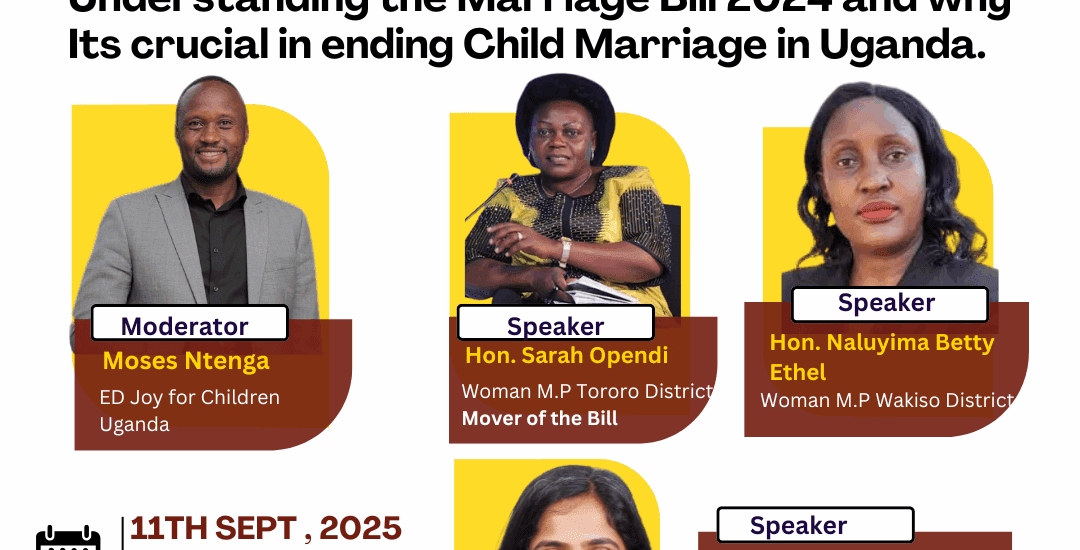
On August 11, 2025, Joy for Children Uganda (JFCU) hosted an X Space discussion on the Marriage Bill 2024. The conversation brought together Civil society advocates, Members of parliament, and international advocates to shed light on the bill’s significance, clarify common misconceptions, and explore its potential to end child marriage and strengthen family protections in Uganda. The event provided an important platform for dialogue, knowledge sharing, and collective advocacy, engaging Ugandans and global audiences in a timely conversation about one of the most pressing child protection issues in the country.
In his opening remarks, Moses Ntenga emphasized that child marriage remains one of the most urgent challenges facing Uganda today, robbing girls of their education, health, safety, and future opportunities. Ntenga highlighted alarming statistics to underscore the scale of the problem: one in five girls globally is married before the age of 18, equating to 12 million girls each year, while an estimated 650 million women alive today were married as children. In Sub-Saharan Africa, 30% of young women were married before turning 18, and in Uganda, the prevalence is even higher at 34%. This figure surpasses rates in neighboring countries like Kenya (23%), Tanzania (29%), and Rwanda (16.5%), pointing to the urgency of legal reforms.
Ntenga further explained that while Uganda’s Constitution prohibits marriage under 18, inconsistencies in older laws have created loopholes that continue to allow child marriages under certain conditions. Although some of these provisions have been challenged and struck down by courts, significant gaps remain, undermining protections for children. He stressed that the Marriage Bill 2024 seeks to close these loopholes by reforming, repealing, and consolidating all of Uganda’s fragmented marriage laws. Beyond outlawing child marriage, the bill addresses recognition and registration of marriages, spousal rights and obligations, property ownership, separation, and dissolution of marriages. By creating a unified legal framework, the bill aims to protect children, strengthen families, and bring Uganda’s laws in line with its Constitution and international human rights obligations.
Key Contributions from Panelists
Hon. Sarah Opendi –Member of Parliament for Tororo District and mover of the Marriage Bill 2024
Hon. Sarah Opendi emphasized that Uganda’s current marriage laws are outdated and inadequate. She reminded the audience that the existing Marriage Act dates back to 1904 and the Divorce Act to 1906 laws enacted before Uganda’s independence that no longer reflect the realities of contemporary society. Because these laws provide limited guidance, judges often issue contradictory rulings on critical issues such as property rights, separation, and divorce. The Marriage Bill, Opendi explained, seeks to address these gaps by offering clear provisions that modernize and consolidate the country’s legal framework on marriage.
Importantly, she noted that the bill makes child marriage a standalone offense for the first time in Ugandan law. No person under the age of 18 may lawfully marry, and consent is a mandatory requirement for any valid union. The bill also places legal responsibility not only on men who marry underage girls, but also on parents, relatives, and community members who facilitate such marriages, ensuring accountability across society. Opendi further highlighted that the bill provides clarity for couples in cohabiting unions, many of whom mistakenly believe they are legally married, only to face devastating consequences in cases of dispute. By aligning with the 1995 Constitution and the Children’s Act, the bill aims to strengthen family structures, safeguard children’s rights, and promote peace and stability in Ugandan homes.
Hon. Betty Naluyima –Woman MP for Wakiso District
Hon. Betty Naluyima stressed that the success of the Marriage Bill will depend on wide sensitization and public support. She pointed out that Uganda’s patriarchal culture continues to shape how legislation is perceived, with many people holding misconceptions that the bill undermines men or threatens family values. To counter these views, Naluyima explained that both Members of Parliament and civil society organizations are working tirelessly to educate the public on what the bill actually contains.
She highlighted several clauses that demonstrate the bill’s strong commitment to protecting children. For instance, Clause 25 outlines grounds for objecting to a marriage, with underage marriage being a key reason for objection. Clause 27 prohibits marriage between certain close relatives, thereby protecting children in blended families from exploitation. Clause 28 explicitly prohibits same-sex marriages, while Clause 44 regulates DNA testing to protect children from psychological harm in paternity disputes. Most significantly, Clause 101 makes marriage involving a child a criminal offense punishable by up to ten years in prison for anyone who conducts, witnesses, or facilitates such a union.
To build momentum for the bill, Naluyima outlined ongoing strategies including public sensitization at community events, engagement with journalists to ensure accurate media coverage, capacity building for local leaders, collaboration with civil society partners like JFCU, and the use of social media campaigns to reach younger audiences. She acknowledged that more must be done, particularly in engaging male MPs and dispelling the myth that the bill is anti-men. She concluded by noting that although sensitization takes time, continuous engagement across Parliament and society will eventually lead to appreciation and passage of the Marriage Bill.
Divya Srinivasan: Global Lead on Ending Harmful Practices at Equality Now
Divya Srinivasan brought a global and regional lens to the conversation. She explained that Uganda has signed several international conventions, including the Convention on the Elimination of All Forms of Discrimination Against Women (CEDAW), which obligate the country to set the minimum age of marriage at 18 for both girls and boys, without exception. Maintaining different standards under civil, customary, or religious law, she warned, amounts to discrimination and contravenes Uganda’s international commitments.
Divya highlighted progressive reforms from across Africa to show that Uganda is not acting in isolation. She pointed to Mozambique’s 2019 reforms, which drew on the SADC Model Law on Eradicating Child Marriage and included provisions mandating that child victims of marriage receive two-thirds of marital property, holding adult perpetrators financially accountable. In Sierra Leone, a 2024 law raised the minimum age of marriage to 18, created Child Marriage Prohibition Officers at district level, and empowered courts to prevent child marriages before they occur. Zimbabwe also set 18 as the minimum marriage age for all types of unions, while addressing concerns about criminalizing consensual teenage relationships by introducing a “Romeo and Juliet” clause.
These examples, Divya emphasized, demonstrate a broader regional trend of aligning national laws with international human rights standards. Uganda’s Marriage Bill, she concluded, is part of this movement, representing not only a national reform but also a commitment to protecting children and strengthening families in line with global best practices.
Addressing Misconceptions
The discussion also focused on the misconceptions and fears that have surrounded the Marriage Bill. Hon. Opendi explained that resistance often stems from misinformation. She outlined four major misconceptions: that Uganda does not need a new marriage law, that the bill encourages divorce, that it legalizes cohabitation, and that it is being pushed by foreign actors. She clarified that existing laws are more than a century old, that the bill only provides clarity for those who choose separation, that cohabitation is not recognized as marriage under the bill, and that the initiative is entirely Ugandan-led. Correcting these misconceptions, she stressed, requires continuous public sensitization and evidence-based advocacy.
Gender Equality in the Bill
Panelists also discussed the bill’s role in promoting gender equality. Hon. Naluyima noted that Uganda’s patriarchal traditions often position men as dominant and women as subordinate, but the Marriage Bill, like the recent Succession Act of 2022, reinforces fairness by recognizing the contributions of both spouses. The bill protects both boys and girls from entering into marriages before the age of 18 and ensures that property acquired during marriage is shared equitably in cases of separation.
Hon. Opendi underscored that equality in marriage is grounded in Uganda’s Constitution, and the bill simply fulfills Parliament’s obligation to operationalize these principles. Divya added that while much focus is placed on girls, boys are also victims of child marriage globally, and Uganda’s law must reflect this reality. Together, the panelists highlighted that the bill is not about privileging one gender over another but about creating healthy, fair, and inclusive marriages that strengthen families.
Audience Feedback
During the audience engagement session, participants raised concerns about provisions on voidable marriages, cohabitation, and polygamy. One participant, Vince, questioned the practicality of dissolving a marriage on the grounds of non-consummation within three to six months, arguing instead for greater emphasis on sexual health education for newlyweds. He also highlighted contradictions around cohabitation and polygamous marriages, urging for clearer definitions to align with existing court rulings and practices.
The audience further recommended that the bill should avoid overlapping with other laws, such as the Children’s Act and the Sexual Offences Act, to maintain focus and clarity. Practical challenges in proving consummation or non-consummation were also flagged, with calls for clearer guidelines. Importantly, participants emphasized that men, too, are affected by certain provisions, underscoring the need for gender-inclusive protections.
Responding to these concerns, Hon. Opendi explained that the bill promotes marriage registration at sub-county levels to ensure legal recognition and protect women. She clarified that voidable marriage provisions are intended to address unreasonable refusals to consummate, while allowing exceptions for genuine health conditions. She reassured the audience that the bill would undergo further refinement in parliamentary committees to ensure a balanced and fair approach.
Call to Action
In her closing remarks, Divya Srinivasan reminded the audience that while legal processes may be slow and complex, the ultimate goal is to protect children particularly girls from early marriage and its devastating consequences. She encouraged stakeholders to maintain momentum through continued advocacy, monitoring, and engagement, ensuring that once the bill is passed, it is effectively implemented to transform the lives of Uganda’s children and families